Silver Sea Glass Jewellery from Cornwall
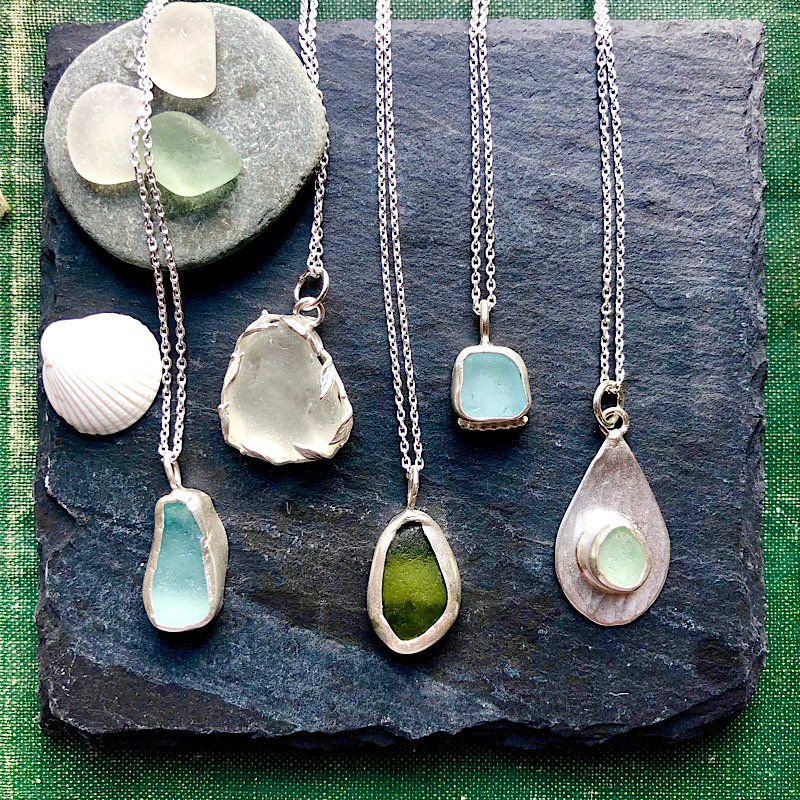
I write here about why I love sea glass…
…and how I find sea glass for jewellery - and share the results with you.
Perhaps my imagination runs away with me, though sea glass jewellery isn’t just pretty. It is unity of human history and the earths elements, each piece with its own unique, secret story.
Sea Glass for Jewellery
I don’t just see sea glass as I pick my way over the beach, Pepper bobbing along nearby. The palm of my hand holds sailors downing shots of rum and slapping each others backs. I clutch a smidgen of an ink bottle from a passionate writer, buzzing with ideas and stories. I see lovers stealing moments on the cliff sharing a bottle of beer. I smell a gentleman’s snuff jar, or the ointment pot’s soothing contents that once lived in a hilltop cabinet decades ago.
These sea glass nuggets hold memories of pre-war kids wearing flat caps or dresses tucked in knickers, drinking coke on the rocks, laughing and skimming stones. Or do I see smugglers on the prowl?
Of course, I don’t condone the casual littering that our beach loving predecessors engaged in. Tut tut; but those were more carefree days. Chucked in the sea, or overboard, bottles left on the beach for the sea to take, forgotten.
Left there for us to find in the decades, or centuries to come.
For our glassy treasures, this was only the beginning. Dashed against rocks for shape, shimmied along and smoothed by pebbles. Our sea glass gem made its way up the beach decade after decade, back and forth. Then one day it winked at me, I collect it up for its destiny, a sea glass jewel now lying in the palm of my hand.
Perhaps my imagination runs away with me, though sea glass jewellery isn’t just pretty. It’s the unity of human history and the earths elements, each with its own secret history.
See my sea glass jewellery collection
How Old is Sea Glass?

Natural Sea Glass
Cast your eye over the black sea glass at the front of the picture. according to www.beachlust.com it is likely to be pretty old:
During the 1700's most liquor ale/beer bottles were mass produced as a cheap container between the 1840's and 1880's bottles were made in a deep, dark olive green colour. This glass may also be from Champagne bottles, Case Gin bottles or dark green wine bottles. One in two thousand pieces of sea glass might be black.
Pirate Glass: This is be backed up by The Sea Glass Company who call it ‘Pirate Glass’ dating this kind of greenish black glass back to the 1700-1800’s. My black sea glass chunk could well be very old indeed, although I have no pirates or sailors from that time to back it up. I am still wondering how to set it - thick silver wire wrapping I think. It is hard to spot - it looks like a pebble but when you hold it up to the light it shines through all that murky history.

There’s a little piece of sea glass in this photo, can you find it?
My Sea Glass Necklaces
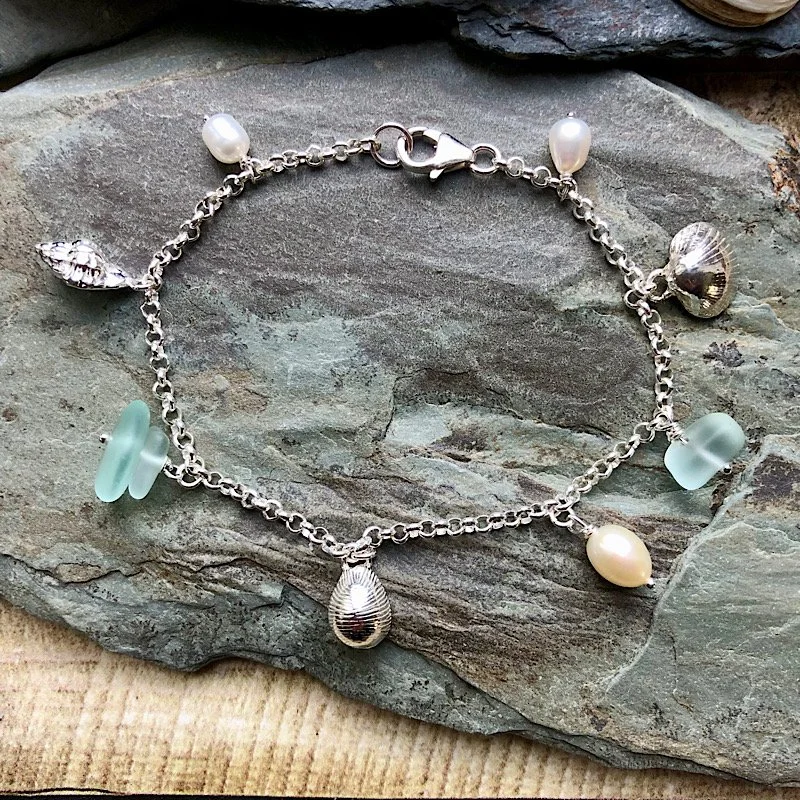
Starting with a wonky shape add in my wonky skills leaves my sea glass necklaces, well, wonky. Charmingly so I like to think. If something has been swishing around in the sea for decades, minding its own business, and then plucked out for celebration and honour: I don’t think the sea glass minds, so why should we? Click to explore: (When they are gone, they are gone!)
Is my Sea Glass Old?
Sea glass can be hundreds of years old - it was made in ancient Egypt and by the Romans, though most will be from the last 200 years.
it would take at least 20-40 years for the sea to tumble to its distinctive smooth finish.
Older sea glass might have bubbles in it since it was handmade.
Old sea glass will be thick, due to how it was manufactured.
You can also use the colour as a guide to age your sea glass, see below.
Different Colours of Sea Glass
My sea glass jewellery collection includes these sea glass colours, and I outline possible origins using information from Beach Combing, which has some lovely pictures of old bottles.
White Sea Glass - most common, used in bottles and jars for centuries.
Sea Foam Sea Glass - Pale aqua, likely to be from pre-world war one Coca Cola bottles and other drinks.
Aqua Sea Glass - 1920’s and earlier bottles, mineral water, ink bottles - read more here.
Brown Sea Glass - likely to be from a beer bottle.
Teal Sea Glass - Utilitarian glass bottles and jars, medicines, ink, etc. Likely from the mid-19th century to the first few decades of the 20th - read more here
Olive Green Sea Glass - After 1900, wine, champagne, beer bottles
Black Sea Glass - Pirate glass, 1700-1800’s.
Amber Sea Glass - used in 1800’s, and again during the depression.
Emerald Sea Glass - Pre-1930’s beer bottles made from Kelly green glass according to Beach Comber . Also newer, beer bottles from the late 20th century - these are likely to be more ragged and thiner.
Blue Sea Glass - Ink bottles, eye ointment, medicines, perfume. You might be lucky enough to find Bristol Blue Glass, a huge manufacturer of blue glass in the 1800-1900’s.
I would like to find an expert from the UK - please let me know if you know one!

How to Find Sea Glass
I confess have only looked on a couple of beaches, neither famed for Sea Glass. (I heard that Seaham in Kent is a good place). You will find sea glass on pebble beaches all along the coast.
Go when the tide is going out, or is already out - when our treasures are newly revealed. If the beach is still wet, the colour shines brighter to catch your eye.
Leave embarrassment at home. The chances are that on a pebbly fishing beach you wont be the only one gazing down looking for sea glass jewels. View competitors as fellow litter pickers and sea glass liberators. A knowing nod goes a long way: they have their patch, you have yours. They too bring the sea glass back to the human world where it can be loved again. Tiny glass mermaids coming home.
Slow down. This is time to re-charge your senses with the sounds of the lapping sea, shingle underfoot and sea gulls. Feel the sand between your toes. Observe the natural colours and shapes. Who knows what else you might find. Tiny worlds filled with sea creatures lie beneath your feet. This is mindful time, or mindless thought wandering if you prefer it.
Be ready to hear the sea glass sing out to you from its pebbly bed. Get down close to scour. Dig.
If you find a good piece, stay to look in that area where its brothers and sisters may be tumbling too.
Before you know it, you will have a pocket full of history.


Cleaning and Selecting Sea Glass
I pop my treasures in a pot with warm water and washing up liquid and swirl them around. I leave for twenty minutes or so to let the soap do its work. The sea is kind of a giant washing machine so we are mainly de-sanding and de-salting. Stray bits of seaweed will float to the surface.
If the edges are too angular it might be difficult to set it into jewellery. It is likely to be more contemporary too, so I am not using so much of that. I resist using a machine rock tumbler to smooth these down, I like the idea of them being shaped entirely by the sea.
If you aren’t making your sea glass into jewellery, display it in a glass jam jar (or something fancier) by the window. If you want them to pop, a smear of oil over the surface, such as coconut oil or almond oil (any really) will bring out the colours. Oil washes off in soapy water if you change your mind.
View the Sea Glass Jewellery Collection
Make a Simple Sea Glass Necklace at home
Sterling silver wire wrapped sea glass: If you aren’t a jewellery designer but want to wear it, order a strip of sterling silver round wire (20-24 gauge probably best) and wrap it around your treasure and form a loop at the top using a chopstick, knitting needle or pencil and attach to a chain. Let me know if you would like more detail.
How to drill a hole in sea glass: Drilling makes me nervous, so I refer you to Kernow Crafts, full of wisdom on sea glass setting - including a tutorial on drilling through sea glass. Then you’ll need an open jump ring or cord to pull through and tie into a necklace. You can buy silver findings, chains and cords at Kernow Crafts too. Aptly, they are a Cornish company.
Making Settings for Sea Glass

It isn’t as easy as it looks, to make a bezel around a funny-shaped stone. (There is a case for buying or tumbing your own uniform shaped sea glass, rather than making necklaces with natural sea glass, though I like the provenance of these naturally formed glass jewels). I don’t mind some rudimentary imperfections (think Wabi Sabi) but if you like things neat my first collection may not be for you. I shared some videos on Instagram Story Highlights if you want to inspect in more detail.
I use recycled silver to make the bezel setting, and of course each one is individually made and I design the setting around the stone. I love the creativity of this process. I shape the bezel strip around the edge and cut. Once it is soldered together, I then cut a suitable piece for the back and cut and file it to shape before soldering the bezel strip on. I add any details - silver pebbles or bobbles. Then I do a final file and sand, then pickle it to remove the oxides, and tumble it in the tumble machine.
If you are looking for a sea themed read, I recommend The Mermaid of Black Conch - it is gorgeous. I listened to it on audible, which had the most fabulous narration.
If you know good sources of information on sea glass please let me know.
Should you find a lovely piece of sea glass you would like me to make into a pendant please get in touch.
Happy beach-coming!
